

News KrakenD CE 2.13.10 and EE 2.13.8 update released

MONOLITH TO MICROSERVICES

MONOLITH TO MICROSERVICES

Extract Services. Not Chaos.

The "monolith is back" narrative is real, and it's not wrong that microservices aren't always the answer, but the problem was never the architecture. It was extracting services without a layer to manage what sits between them.

Request a Demo

The Cost of Extraction

The Problem Between Services

Different teams, different scales, the same gap: nobody owns what happens between the services once there is more than one.

Cross-Cutting Concerns Duplicated Across Every Service

Without a gateway, every new service implements its own version of JWT validation, rate limiting, CORS, and response transformation. At 5 services it is manageable. At 500, every team is solving the same problem independently, and no team owns the full picture. Hepsiburada standardized JWT authorization across 500 microservices and 40 teams behind a single enforcement point, running in 800 containers in production.

Read the Case Study »

KrakenD is the best API Gateway and has helped us reduce the complexity of dealing with 500 microservices.


Alper Hankendi Engineering Director, Hepsiburada

The Client Is Coupled to Your Internal Architecture

When you extract services, the client suddenly needs to know about your internal service boundaries. Change a backend and the client breaks. Add a service and the client needs updating. The frontend team becomes dependent on every backend team's release cycle. Showpo replatformed from a five-year-old Salesforce Commerce Cloud monolith to headless Shopify Plus with KrakenD as the BFF: four backend services now resolve behind a single endpoint, backend load down 40%, deployments 20 to 25% faster, zero downtime.

Read the Case Study »

KrakenD gave us the scalability and reliability to grow our product offering with confidence, while cutting the operational overhead that was holding us back.

Team Autonomy Stalls Without the Right Layer

Without a gateway, any API change requires a ticket to a centralised infrastructure team. Every team waits on every other team. The migration slows to the pace of the bottleneck, not the pace of the work. lastminute.com took a decade to evolve to 500+ microservices across 50 teams once each team could manage its own OpenAPI-driven gateway config, deployed through CI/CD. Adevinta made the same move earlier, replacing Zuul with KrakenD so any developer, not just infrastructure specialists, could manage the gateway. If you are evaluating a move from a specific gateway rather than a monolith, see migrating from Kong or the full migration guide index.

Read the Case Study »

KrakenD played a vital role in our API transformation journey by protecting our business platforms boundary and exposing the business capabilities in a standard way to both internal and external audience.

Stefano Leopizzi Enterprise Architecture, lastminute.com

At Scale, Cross-Cutting Complexity Becomes an Organizational Problem

Standardizing how 750+ developers across hundreds of services handle auth, routing, and observability cannot be solved service by service. Without a shared enforcement layer, every team diverges, every incident is harder to trace, and every new service reinvents the wheel. Rappi's developers celebrated killing their monolith in 2021 with "I killed the monolith" t-shirts. Today: 3,500+ microservices behind 20+ KrakenD gateways by functional group, JWT standardized via Auth0, full rollout in one month despite the scale.

Read the Case Study »

We didn't have to fight.

Nicolás Vila Engineering, Rappi

The Differentiator

KrakenD Is More Than a Reverse Proxy. It Composes.

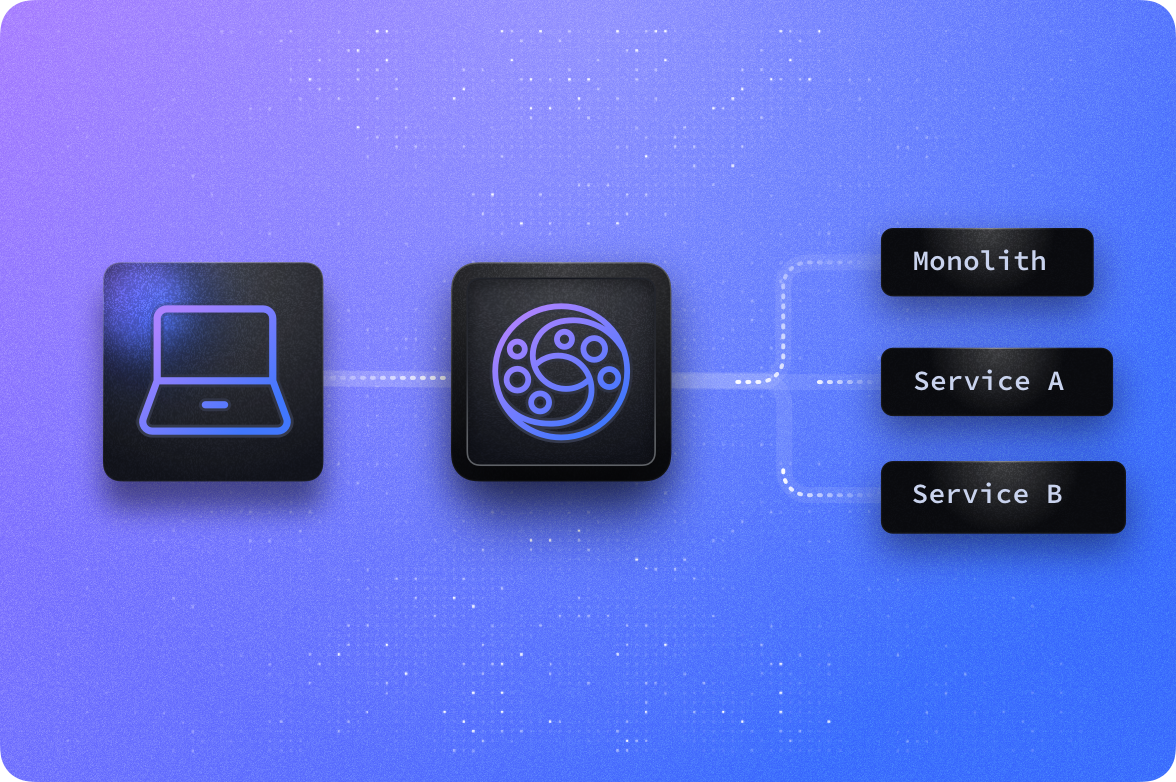
A reverse proxy routes one request to one backend. KrakenD fans out to many, merges the responses, and returns one coherent object to the client.

During a migration, that difference is everything. When some data still lives in the monolith and some has moved to a new service, a reverse proxy forces a choice: duplicate data, break the client contract, or freeze the migration. KrakenD removes that constraint. Extract services at your own pace. The client never sees the seams.

Diagram: a client request flows through KrakenD, which fans out to the monolith and extracted services and merges the responses

Incremental Migration

How It Works in Practice

Put KrakenD in Front of the Monolith

Nothing changes for the client. Everything changes for you: auth, rate limiting, caching, and observability move to the gateway immediately. The monolith stops implementing cross-cutting concerns.

Extract Your First Service

Route the new path to the extracted service. Everything else still hits the monolith. The client calls the same endpoints as before.

Compose Responses Across Both

When a client request needs data from the monolith and the new service simultaneously, KrakenD combines both into a single response before it reaches the client. No client change, no data duplication, no migration freeze.

Filter What Each Backend Receives and Returns

Strip fields the new service does not need. Remove data the client should not see. KrakenD handles payload shaping at the gateway, with no changes to either backend.

Retire the Monolith Piece by Piece

When a capability is fully extracted, update the routing config. The client never knows. Repeat until the monolith is gone, or until you decide you have extracted enough.

Relax, Enjoy, and Celebrate

The migration is done. The gateway that got you through it is the same one running everything now. Take the win.

No Rip and Replace

Works With Your Existing Stack

You are not replacing your architecture. You are adding a composition layer in front of it. Business logic, data models, and service-specific processing all stay exactly where they are. If your new services call LLMs, the same gateway enforces AI governance alongside everything else.

Strangler Fig Ready

KrakenD routes by path prefix. Point new paths to extracted services, legacy paths to the monolith. The client calls one endpoint throughout the migration.

API Composition Native

One client request, multiple backends queried at once, one response assembled from all of them. Useful during migration and after.

Stateless and Kubernetes-Native

Deploys as a standard Docker image. No operator, no CRDs. Each instance runs independently. Config lives in Git.

Cross-Cutting Concerns in One Place

JWT, OIDC, mTLS, API keys. Rate limiting per endpoint or per client. Request and response transformation. HTTP caching. OpenTelemetry to Grafana, Datadog, New Relic, your SIEM.

BFF Pattern Native

Multiple backend services aggregate into a single endpoint per client type: web, mobile, partner. The frontend calls one API.

SOAP Backends Supported

If your monolith exposes SOAP services, KrakenD transforms them to REST natively in declarative config. Modern clients consume REST. The monolith never needs to know.

KrakenD: One gateway for APIs & AI Workloads
image G2 High Performer, Fall 2026
image G2 Momentum Leader, Fall 2026
image G2 Easiest Admin, Mid-Market, Fall 2026
image G2 Fastest Implementation, Small-Business, Fall 2026
image G2 Users Love Us, Fall 2026

Independently Verified

Verified by G2 Users

G2 Fall 2026 API Management, Mid-Market segment: KrakenD customers recover their investment in 3 months (category average, 11.65 months). Quality of Support scores 98%, the highest of any vendor in the table.

Source: G2 Fall 2026 API Management reports, Mid-Market segment. Data collected through July 28, 2026. Third-party verified peer reviews, not vendor claims.

98% Quality of Support, Mid-Market, the highest of any vendor in the category
100% of implementations done
in-house, no consultants
2 months average time to go-live, Mid-Market segment

Monolith to Microservices FAQ

Frequently Asked Questions

1. Does KrakenD decompose my monolith for me?

No. KrakenD does not refactor your codebase, extract your services, or decide which parts to break apart. If the question is whether you should break up your monolith, KrakenD does not answer it. What KrakenD answers is what happens once you have more than one backend: how you manage what sits between them and the clients that call them. Whether that is one extracted service alongside a monolith, or 3,500 microservices serving a Super App, the layer is the same.

2. Is this only relevant if I am actively migrating away from a monolith?

No. The composition layer KrakenD provides is useful any time you have more than one backend serving the same client. Whether you are mid-migration, post-migration, or pre-migration and still on a monolith but planning ahead, the cross-cutting concerns problem is the same.

3. How does API composition make migration safer?

It eliminates the hardest constraint of incremental migration: the moment when a single client request needs data from both the monolith and a newly extracted service. A reverse proxy cannot serve both in one response without breaking the client contract. KrakenD calls both backends in parallel and stitches the results into a single response. You extract services at your own pace without coordination pain.

4. Does KrakenD help with the strangler fig pattern specifically?

Yes. KrakenD routes traffic by path prefix. You point new paths to extracted services and legacy paths to the monolith. For endpoints that need data from both, KrakenD composes the response. The client calls the same endpoint throughout. When the monolith is retired, only the routing config changes.

5. What happens to cross-cutting concerns during the migration?

They move to KrakenD on day one, before any service is extracted. JWT validation, rate limiting, caching, and observability stop living in individual backends and start living in the gateway. Each extracted service inherits those controls automatically, with no additional implementation required.

6. Can different teams manage their own KrakenD instances?

Yes. lastminute.com runs this model across 50 teams. Each team manages its own gateway config as part of its normal development cycle. Config is declarative JSON, versioned in Git, deployed through CI/CD. Adevinta went further: any developer on the team can manage gateway configuration, not just infrastructure specialists.

7. What is the difference between KrakenD and a reverse proxy in this context?

A reverse proxy routes one request to one backend. KrakenD composes: it can call multiple backends simultaneously, merge their responses, filter fields, and return a single coherent object to the client. During a monolith-to-microservices migration, this is the difference between extracting services without breaking clients and having to coordinate API contract changes with every consumer before you can move.

8. Does KrakenD handle SOAP backends from a legacy monolith?

Yes. KrakenD handles SOAP transformation natively in declarative config. If your monolith exposes SOAP services and you want to expose them as REST to modern clients, that transformation lives in the gateway. No backend changes required.

9. We are still evaluating whether to migrate. Is it worth talking to KrakenD now?

Yes, because the gateway question is independent of the migration decision. Whether you decide to stay on the monolith, extract some services, or go fully distributed, the cross-cutting concerns layer has the same value. Understanding what that layer looks like before you start extracting services is what makes the strangler fig pattern safe in practice.

Request a Demo

Walk through your own migration: which services to extract first, how to compose responses across the monolith and the new backends, and how to keep cross-cutting concerns in one place from day one.

Request a Demo    See How KrakenD Works

Stay up to date with KrakenD releases and important updates