

9 min read
Choosing an API Gateway for Aggregation and BFF: A Practical Checklist
by Toni Pinel
Choosing an API gateway for API aggregation and backend for frontend (BFF) means evaluating how effectively it combines services, shapes responses, handles failures, and supports production operations.
A well-designed gateway can reduce client-to-service calls, simplify frontend development, and improve data delivery. However, fewer client requests do not automatically mean lower latency or fewer upstream operations.
Postman’s 2025 State of the API Report, based on more than 5,700 respondents, found that 31% of organizations used multiple API gateways. While 57% performed performance testing, only 17% conducted contract testing.
These findings provide context for API platform selection, but do not measure aggregation performance. This practical checklist explains which capabilities to evaluate, how to test them, and how KrakenD supports aggregation and BFF architectures.
What Are API Aggregation and Backend for Frontend (BFF)?
API aggregation combines data from multiple backend services into a single client-facing response. It reduces the number of requests clients need to make for a particular use case.
Backend for frontend (BFF) is an architectural pattern that provides APIs tailored to specific interfaces, such as mobile applications, web applications, or connected devices.
API Aggregation vs. BFF: Key Differences
- API aggregation: combines multiple service responses into one representation.
- BFF: adapts API contracts and operations to frontend requirements.
- API gateway: can implement aggregation, transformation, security, and traffic controls.
A BFF can use aggregation, but not every aggregated endpoint implements a BFF architecture.
For straightforward integrations, a configurable API gateway may eliminate the need for a separately developed BFF service. Complex business workflows may still require application-level logic.
How Does an API Gateway Reduce Client-to-Service Calls?
Consider a mobile application that needs profile, catalog, pricing, and inventory information. Without aggregation, it might contact four separate APIs.
An aggregation endpoint lets the application request the required information once. The gateway retrieves the relevant backend data and builds the response.
However, reducing client calls is different from reducing upstream calls. One client request may still generate four backend requests.
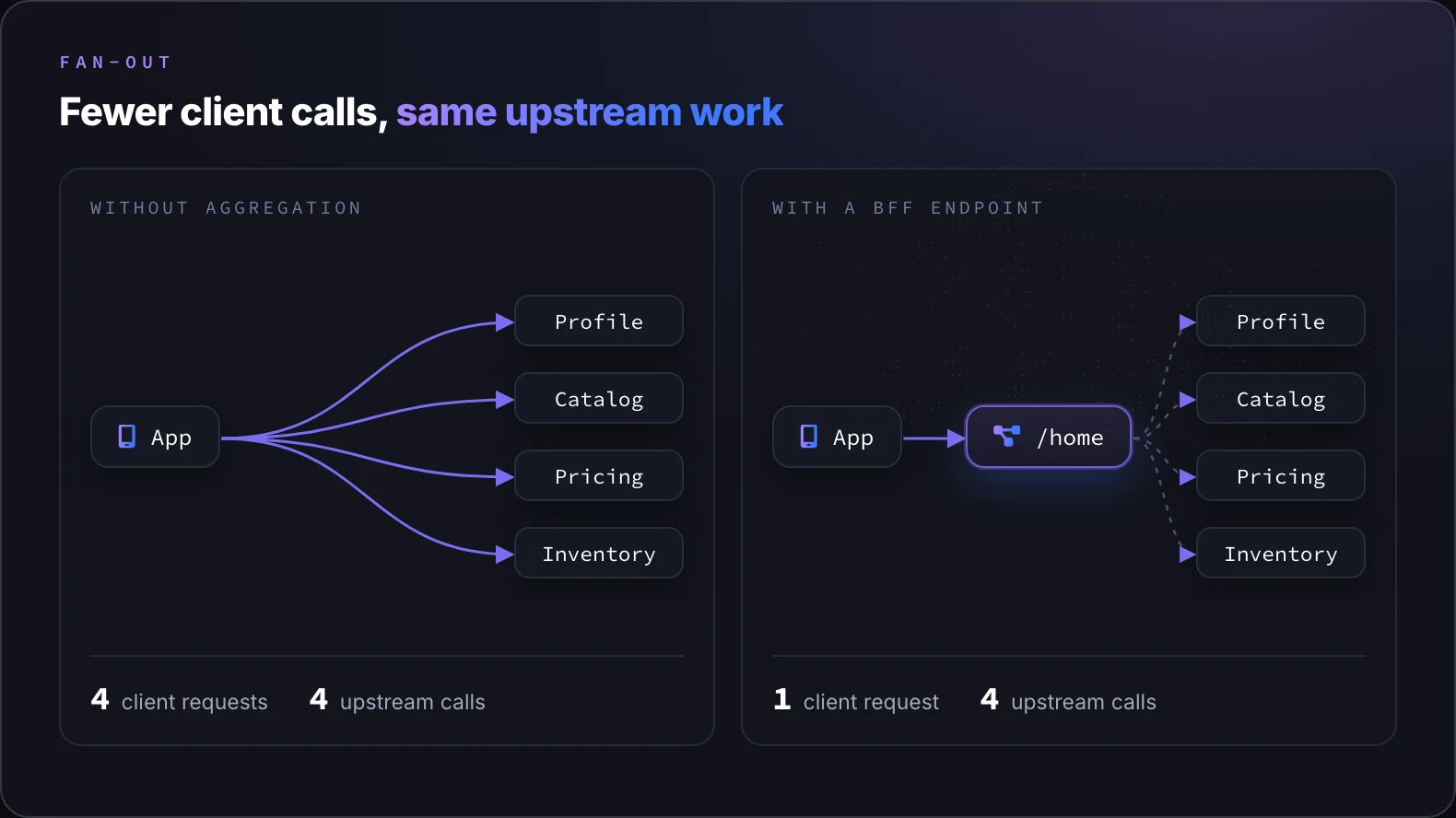
Parallel Requests, Fan-Out, and Latency
Fan-out describes the upstream operations triggered by one incoming request. A gateway can execute independent operations in parallel or dependent operations sequentially.
Parallel aggregation overlaps waiting time. Its total duration still depends on network conditions, gateway processing, and the services required to complete the response.
Sequential operations should be reserved for genuine dependencies because each additional step extends the request’s critical path.
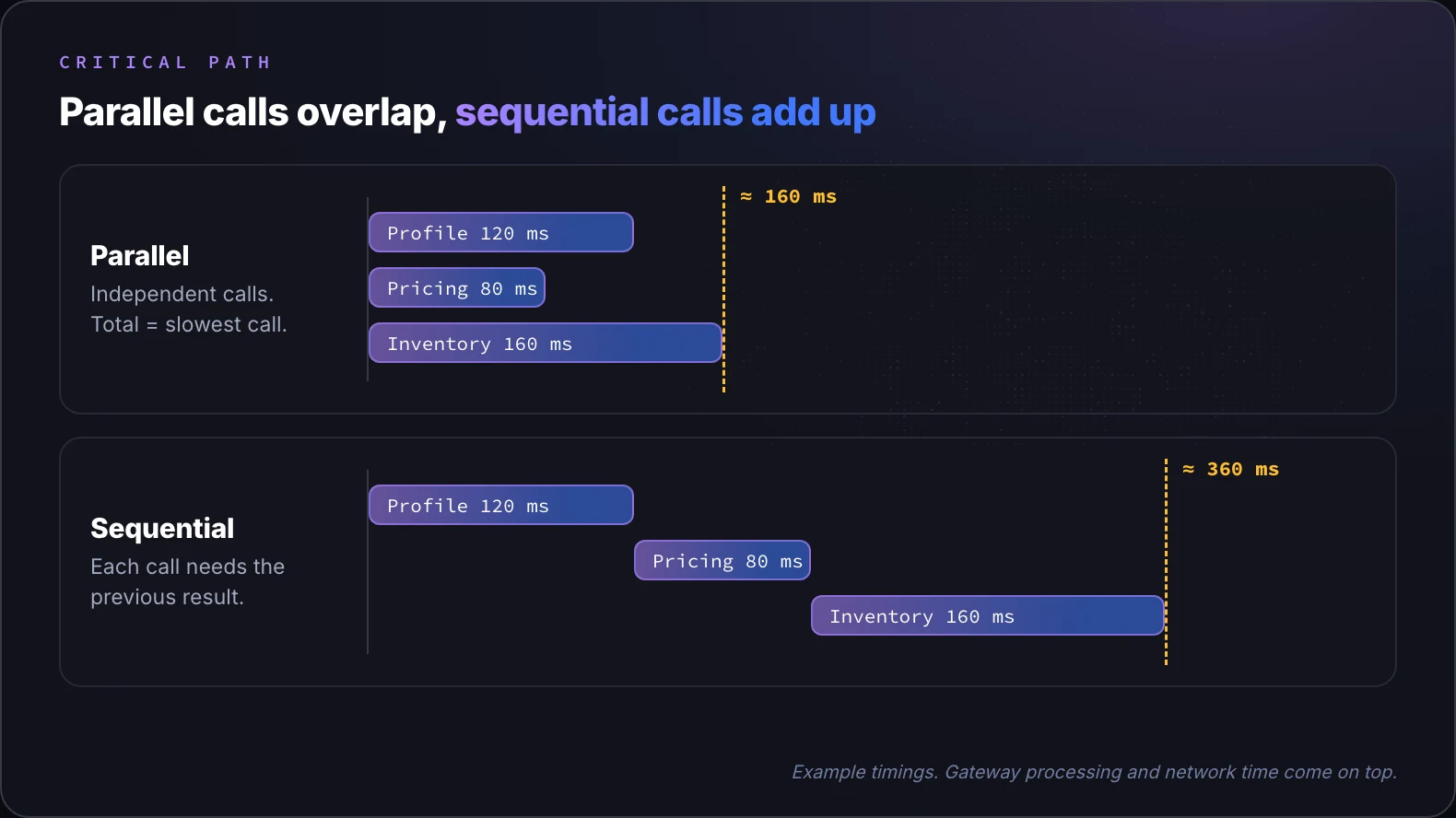
Evaluate client request count, upstream fan-out, transferred bytes, and end-to-end latency separately. This distinguishes architectural simplification from demonstrated performance improvements.
Checklist: Does the Gateway Support Response Shaping?
Response shaping transforms upstream data into the structure required by a consuming application. It reduces unnecessary payload content and decouples frontend contracts from backend representations.
Filtering, Mapping, Grouping, and API Contracts
- Filtering: include required fields and exclude unnecessary attributes.
- Mapping: rename or restructure fields for client compatibility.
- Grouping: preserve logical boundaries between aggregated resources.
- Collection handling: transform arrays and nested structures correctly.
- Contract validation: verify expected data types and required attributes.
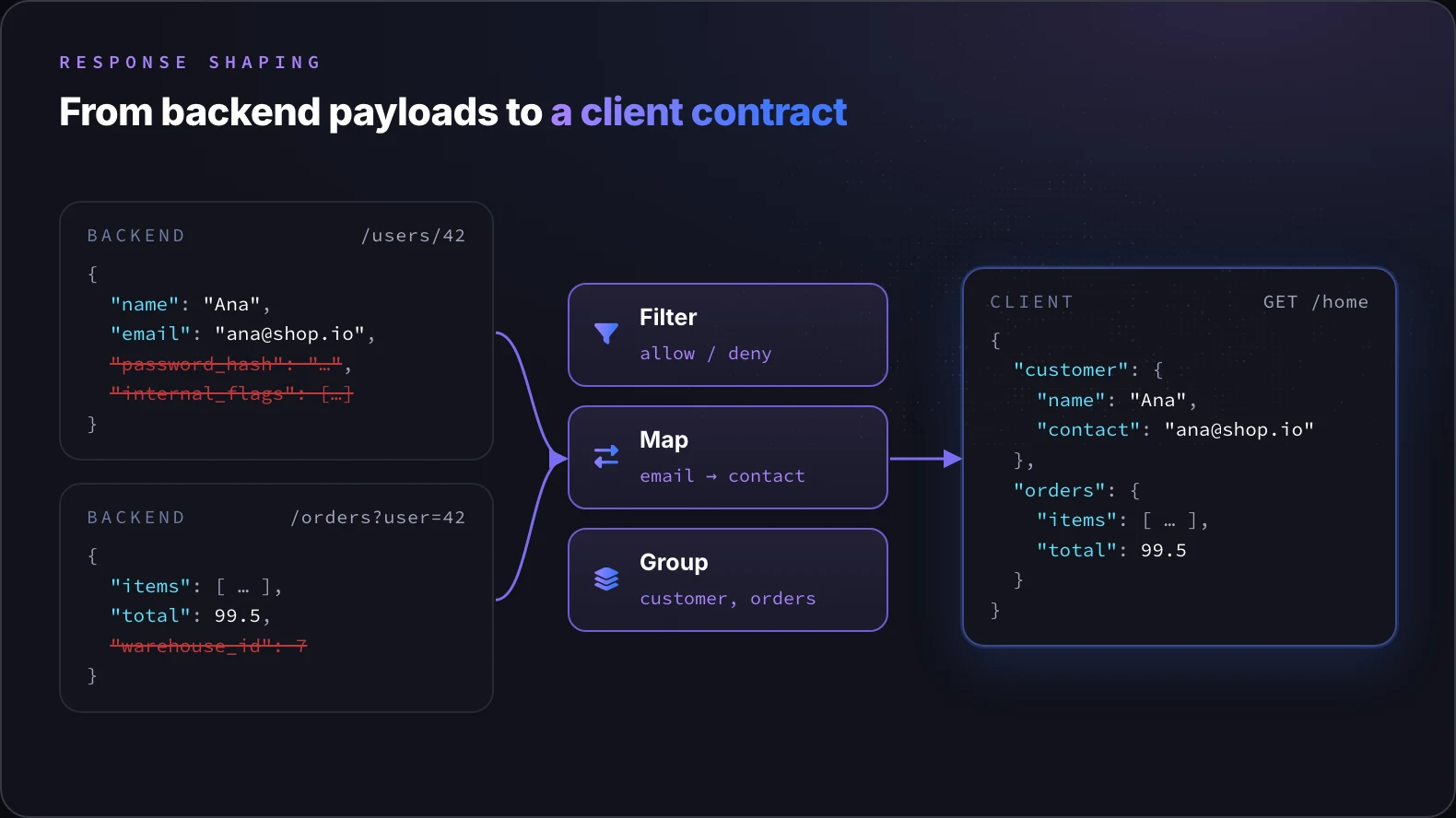
Test response shaping against realistic payloads, including missing fields, empty collections, and overlapping attribute names.
In KrakenD, basic allowlists, denylists, mapping, and grouping support declarative transformation. Array manipulation requires collection-specific operations.
Response filtering does not replace authorization. Sensitive information must remain protected even when a client requests fields that are not included in its normal presentation.
Checklist: Can It Handle Partial Failures and Timeouts?
Graceful degradation allows an aggregation endpoint to return useful data when optional backend dependencies fail.
Its implementation must distinguish between information that is essential and information that can be omitted without compromising the application.
Complete Responses, Partial Results, and Error Policies
- Complete response: all required backend results are available.
- Partial response: some results are missing but available information can still be returned.
- Timeout: the gateway stops waiting when the configured deadline expires.
- Total failure: no usable backend results are available.
KrakenD’s default JSON aggregation supports partial responses and configurable error-handling strategies. A request may return HTTP 200 even when one backend fails.
The X-KrakenD-Completed response header indicates whether all backend operations completed successfully. A value of false identifies an incomplete aggregate.
When no backend succeeds, the default aggregation behavior returns HTTP 500.
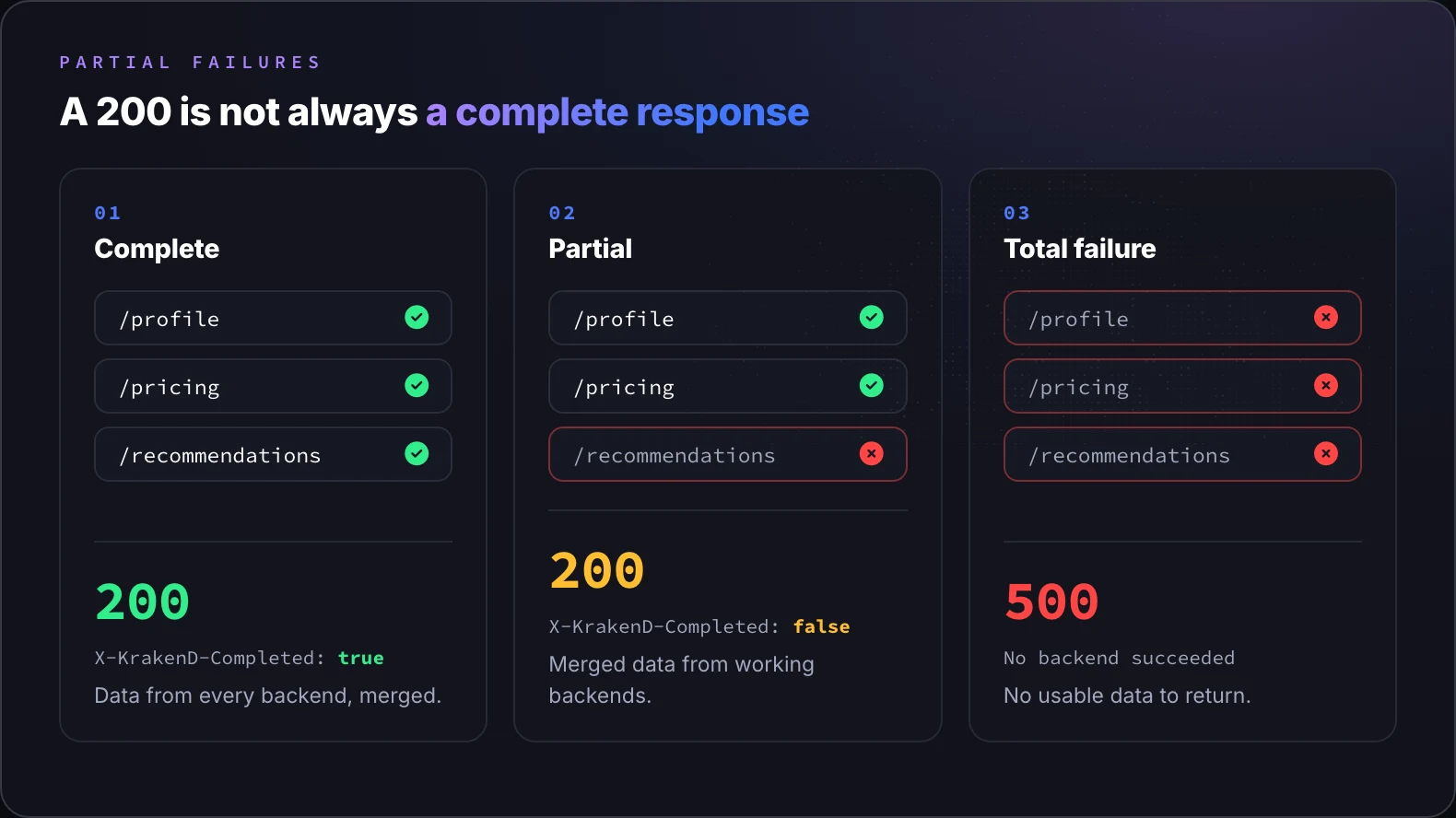
Verify how clients interpret missing data, HTTP status codes, and completeness signals. An HTTP 200 response alone does not guarantee a complete result.
Checklist: Does Caching Reduce Upstream Load Safely?
Backend caching stores eligible service responses for reuse. It can reduce repeated upstream requests, network traffic, and backend processing when identical requests occur within an acceptable freshness window.
Cache Eligibility, Freshness, and Data Isolation
- Eligibility: identify read operations suitable for caching.
- Freshness: establish expiration rules that reflect data volatility.
- Cache keys: distinguish requests using relevant URL and request variations.
- Isolation: prevent private responses from being reused across unauthorized users.
- Capacity: monitor memory consumption and eviction behavior.
KrakenD’s HTTP caching component stores individual backend responses rather than the final aggregated payload.
Its in-memory cache uses backend directives such as Cache-Control and Vary. Eligible backend requests can be served from cache without contacting the origin again.
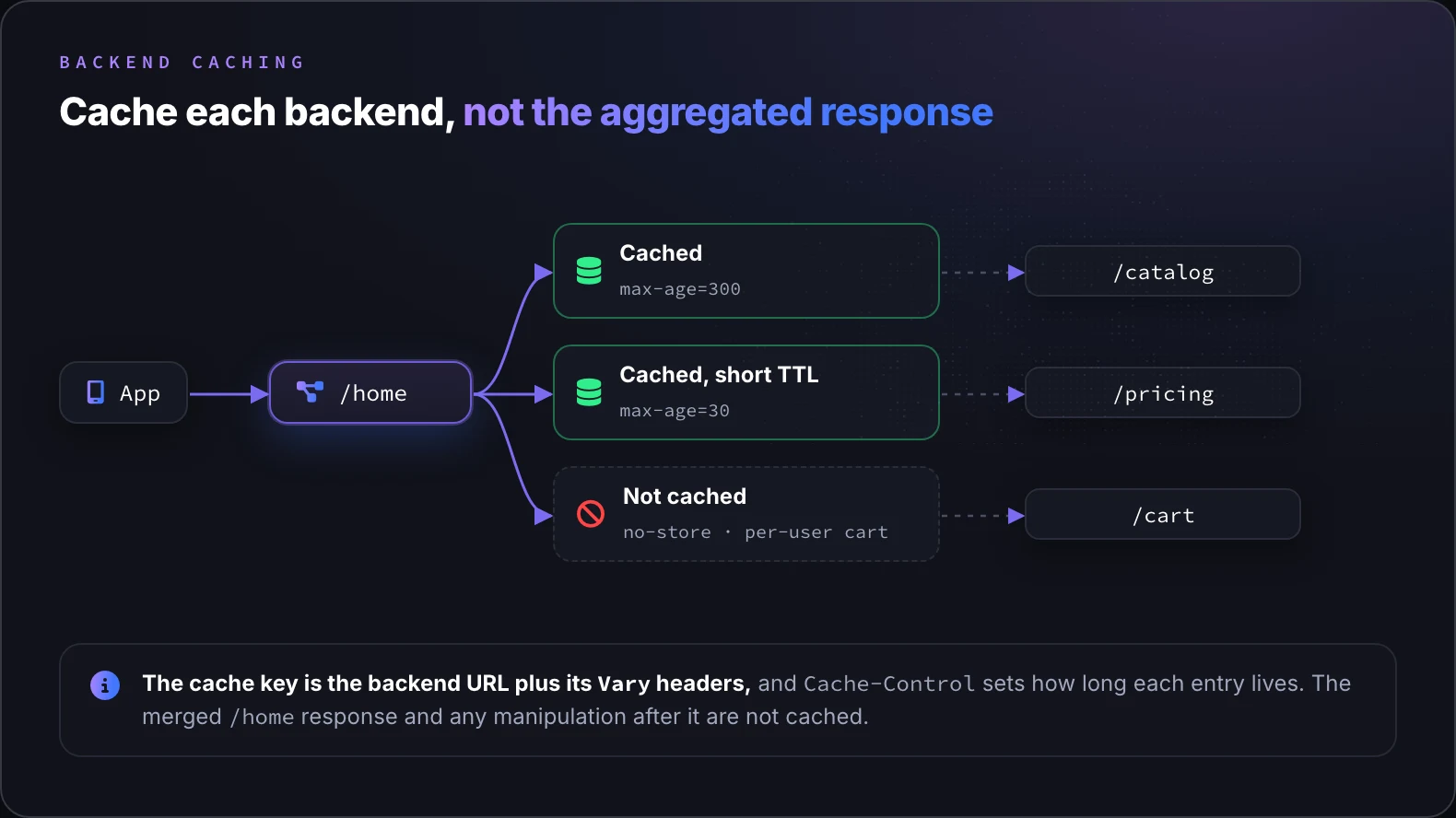
Pricing, inventory, and personalized information require particular care. Evaluate cache hit ratio, stale responses, and memory consumption before enabling caching in production.
Checklist: Can Teams Observe Aggregation Performance?
Aggregation observability connects an incoming API request to its backend operations, response transformations, failures, and final delivery.
Distributed tracing is especially useful because multiple upstream requests can execute simultaneously.
Essential API Gateway Performance Metrics
- End-to-end latency: p50, p95, and p99 response times.
- Backend latency: request duration for each upstream service.
- Reliability: errors, timeouts, and partial-response frequency.
- Efficiency: upstream request counts, payload size, and cache hit ratio.
- Infrastructure: CPU, memory usage, and throughput under load.
KrakenD supports OpenTelemetry metrics and distributed traces across gateway processing layers.
When requests execute in parallel, summing backend durations and subtracting them from total response time produces misleading overhead estimates.
Instead, inspect sampled traces to identify slow dependencies, critical paths, and gateway processing costs. KrakenD’s documentation on OpenTelemetry layers and metrics explains how to interpret these measurements.
Checklist: Is the Gateway Secure and Maintainable?
Security and maintainability determine whether an aggregation architecture remains reliable as applications evolve.
Verify caller authentication, authorization boundaries, credential handling, and permitted data exposure. Backend services must enforce their own relevant access requirements.
Prefer configuration that can be versioned, validated, tested, and deployed consistently through existing CI/CD automation.
API contracts should also support controlled changes. A renamed upstream field must not silently corrupt the data returned to client applications.
Keep complex domain logic outside the gateway when it creates unnecessary coupling or makes behavior difficult to maintain.
Practical Example: A Mobile BFF for Multiple Services
Consider a mobile commerce screen showing customer information, featured products, prices, and inventory availability.
Without aggregation, the application requests each resource separately. With a BFF endpoint, the gateway can collect the required information and return a tailored response.
Before vs. After: Evaluating the Architecture
- Client requests: four independent requests become one BFF request.
- Upstream operations: four backend calls may still occur, unless caching or other optimizations avoid them.
- Response shaping: the gateway returns only the fields needed by the mobile interface.
- Error handling: optional recommendations may be omitted while essential pricing follows stricter rules.
- Observability: traces identify slow services and incomplete responses.
The expected architectural benefit is simpler client communication. Lower latency, reduced bandwidth, and improved resource efficiency remain outcomes that must be verified.
Compare both designs using equivalent traffic, payloads, authentication requirements, and failure scenarios.
How Should Teams Compare API Gateways for Aggregation and BFF?
A practical API aggregation platform selection framework should evaluate technical capabilities through measurable acceptance tests.
API Gateway Selection Checklist
- Aggregation: can the gateway combine independent services while controlling fan-out?
- Response shaping: can it produce a stable, validated client contract?
- Error handling: does it distinguish partial failures from complete results?
- Caching: can it reduce upstream traffic without violating freshness or isolation requirements?
- Observability: can engineers trace requests across every participating service?
- Performance: does it satisfy latency and throughput requirements under representative load?
- Operations: can teams maintain and deploy configurations safely?
Classify requirements as mandatory or optional. Test the same workloads and failure conditions across candidate implementations.
A synthetic reverse-proxy benchmark cannot establish aggregation performance. Include realistic concurrency, response manipulation, cache behavior, and backend latency.
The preferred gateway is the one that meets the application’s requirements with acceptable complexity and demonstrable operational behavior.
How Does KrakenD Support API Aggregation and BFF?
KrakenD Community Edition provides declarative API aggregation, response manipulation, and BFF-style endpoints without requiring custom code for straightforward composition scenarios.
Its core capabilities include parallel backend requests, field filtering, mapping, grouping, sequential proxying, HTTP backend caching, and OpenTelemetry integration.
These features allow teams to define client-specific API contracts while keeping existing backend services independently maintained.
Community Edition and Enterprise Extensions
KrakenD Community Edition supports the fundamental aggregation and BFF capabilities described in this checklist.
KrakenD Enterprise extends these capabilities with advanced workflows that can combine sequential and parallel operations, conditional execution, and more complex orchestration.
Enterprise functionality is not required for basic aggregation or straightforward BFF implementations.
KrakenD recommends keeping gateway configuration focused on response composition and integration rather than embedding extensive business logic.
Explore KrakenD Open Source and review its technical documentation to evaluate aggregation, transformation, caching, and observability capabilities.
Frequently Asked Questions About API Aggregation and BFF
Can an API Gateway Aggregate REST and gRPC Services?
Yes, when the gateway supports the required protocols and response conversion. KrakenD Enterprise provides gRPC client integration, enabling gRPC backend data to be exposed through REST-compatible responses.
Who Should Own the Backend-for-Frontend API Contract?
The frontend-owning team should define the BFF contract with platform and backend teams. Responsibilities include required fields, versioning, compatibility, and acceptance tests.
How Should a BFF Handle Pagination Across Multiple APIs?
A BFF should expose a consistent pagination contract. Combining independently paginated datasets may require cursor coordination, stable ordering, or application-level processing beyond basic aggregation.
Conclusion: Choose an API Gateway Based on Technical Evidence
Choosing an API gateway for aggregation and BFF requires evaluating how client requests become backend operations and how responses remain secure, complete, and measurable.
Response shaping, failure handling, caching, observability, and maintainability should guide platform selection alongside throughput and latency.
KrakenD Community Edition provides core API aggregation and BFF capabilities through declarative configuration, while Enterprise offers extensions for advanced orchestration.
Start with representative workloads, validate the response contract, measure performance, and choose the architecture that meets your operational requirements.