News KrakenD CE 2.13.10 and EE 2.13.8 update released

Migrate From Kong to KrakenD:

Migrate From Kong to KrakenD:

Keep the API Gateway, Lose the Overhead.

You chose Kong because it solved the gateway problem. It still does. But the gateway is not the bottleneck. The total cost of running it is.

Start the Migration Conversation

The Hidden Kong Bill

The Three Costs That Don't Appear on Your Kong Invoice

The first part is the license. The second is the operational overhead. The third is the growth tax. Most teams discover part two after the first major upgrade. They discover part three when they're too embedded to leave.

Plugin Maintenance Is Recurring, Not One-Time

Every Kong upgrade requires re-validating custom Lua plugins. For teams with SOAP transformations, custom auth logic, or payload manipulation, that means a mini-project on every major version. The team that built those plugins may no longer be there when the next one breaks.

A Stateful Gateway Is a More Complex Gateway

Kong stores its configuration in a database, PostgreSQL in OSS, a control plane in Enterprise. That database is in your critical path. Managing it in Kubernetes, keeping it consistent across environments, and recovering it under failure adds operational surface area a stateless gateway simply does not have.

The More You Grow, the More Kong Costs

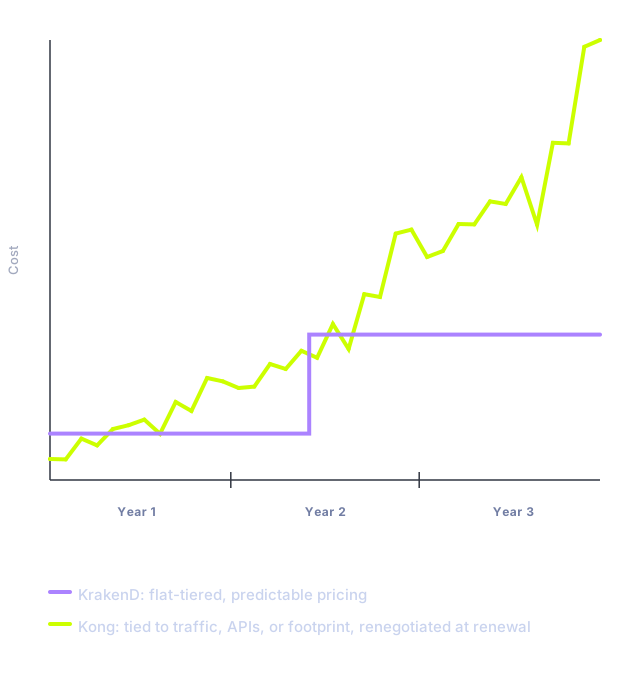
Kong's Enterprise pricing scales with your traffic, your API count, or your service footprint depending on your contract. Every new team, every new product line, every traffic spike is a renegotiation waiting to happen. That model works when you're small. At scale, there is no ceiling.

KrakenD is priced by flat-tiered plans. The team you are today and the team you are in three years pay the same rate per tier. Predictable infrastructure cost is a competitive advantage. Unpredictable cost is a tax on growth.

The Migration Payoff

What Changes With KrakenD

Config, not code. Stateless by design. Try before you commit. One price model that never changes. Your Kong config is not wasted. And you will not need a consultant.

Config, Not Code

SOAP transformation, JWT validation, rate limiting, payload manipulation, response filtering, all declarative JSON config. No plugins to write, no Lua to maintain, no re-validation on upgrade. Releases tend to remove workarounds teams had built, not require new ones.

Config, Not Code

Stateless by Design

No database in the critical path. No control plane as an external dependency. Configuration lives in Git, baked into a Docker image, deployed through your existing CI/CD pipeline. Rollback is a Docker tag.

Stateless by Design

Try Before You Commit

KrakenD's Community Edition is the same runtime as Enterprise. Teams deploy it against real infrastructure, validate the approach, and start a license conversation only after the technical case is closed. No sales-gated trial.

Try Before You Commit

One Price, No Feature Tiers

KrakenD Enterprise is priced by flat-tiered plans. Every feature, including RBAC, OIDC, rate limiting, SOAP, gRPC, WebSockets, observability, and AI Gateway, is included at every tier. What never changes is the model: flat per plan, no traffic-based uplift, no renegotiation when your API call volume doubles.

One Price, No Feature Tiers

Your Kong Config Is Not Wasted

KrakenD's declarative model maps cleanly from Kong's route and plugin structure. Teams that have migrated report the translation is mechanical, not architectural. Start with a subset of low-complexity routes, validate in parallel, and expand incrementally.

Your Kong Config Is Not Wasted

You Will Not Need a Consultant

G2 Fall 2026 API Management: 100% of KrakenD Mid-Market implementations are done in-house, with no vendor services and no external consultants. Average time to go-live: 2 months. Kong averages 3.9 months in the same segment and requires partner services in 11% of implementations.

You Will Not Need a Consultant

Drop-In Compatibility

What Doesn't Change With KrakenD

You are not migrating your infrastructure. You are replacing one gateway config with another. Everything around it stays.

Deploys Like Any Stateless Workload

KrakenD runs as a standard Docker image via Kubernetes manifests. No operator, no CRDs, no new abstractions. Dev and staging instances are unlimited across all plans, so you can run Kong and KrakenD in parallel across as many non-production environments as your migration requires, at no additional cost. Validate route by route before a single production request moves.

Your Observability and Auth Stack Stay Untouched

Native OpenTelemetry means your existing Prometheus, Grafana, Datadog, New Relic, or SIEM setup works without modification. Auth is the same story: JWT, OIDC, mTLS, API Keys, and OAuth2 are all native, no plugin required. If your current Kong setup validates tokens, KrakenD handles the same flows in declarative config.

No Protocol Left Behind

REST, gRPC, GraphQL, WebSockets, SOAP, Kafka, AMQP. No protocol support is lost in the migration. Each instance handles 40,000 to 80,000 RPS with stateless horizontal scaling, no Redis coordinator, no shared state between nodes.

The Cost Curve

What Happens to Your Gateway Cost When Traffic Grows

Kong's Enterprise pricing has a structural trap. What you pay is tied to your traffic volume, your API count, or your service footprint depending on the contract you signed. As your business grows, at least one of those variables grows with it. Every new team, every new product line, every new integration is a potential renegotiation.

The second problem is that the ceiling keeps moving. Features that were included in your current tier may not be in the next. Kong has a track record of moving capabilities between tiers across versions. You find out at renewal, when switching costs are highest.

KrakenD is priced by flat-tiered plans. A traffic spike that doubles your call volume does not change your invoice. A record-breaking sales day costs the same as a quiet Tuesday. Your gateway cost is a line in the annual budget, not a variable you track weekly. Scale your traffic as fast as your business demands. The gateway bill stays the same.


Chart: KrakenD's flat-tiered cost versus Kong's volatile, ever-rising traffic-based cost over three years
KrakenD: One gateway for APIs & AI Workloads
image G2 High Performer, Fall 2026
image G2 Momentum Leader, Fall 2026
image G2 Easiest Admin, Mid-Market, Fall 2026
image G2 Fastest Implementation, Small-Business, Fall 2026
image G2 Users Love Us, Fall 2026

Independent Data: G2 Fall 2026 API Management

Independent Data: G2 Fall 2026 API Management

Metric

KrakenD

Kong

NPS, Europe

8553

NPS, Mid-Market Europe

8747

ROI payback, Mid-Market

3 months11 months

Quality of Support, Mid-Market

98%87%

Time to go-live, Mid-Market

2 months3.9 months

In-house implementation, Mid-Market

100%79%

Mid-Market Europe quadrant

High PerformerContender

Source: G2 Fall 2026 API Management reports. Data collected through July 28, 2026, published August 25, 2026. All figures are third-party verified peer reviews, not vendor claims.

They Evaluated Kong. They Chose KrakenD.

We had tried other API gateways like Kong, but KrakenD was the first that solved our problems without introducing new complexity. Every release removes workarounds we had built, and that has been a huge relief for our developers.

William Wiltse CTO, Child Rescue Coalition
Read the Case Study »

With Kong and Apigee, you can't start small. The pricing doesn't allow it. As an R&D department, we were like: cool, these guys are open source. We can try it out and deploy it even before licenses are involved.

Nicolaas Taljaard Head of Technology Strategy and Partnership, Moniepoint

What About AI?

Kong's AI Gateway Is a Plugin. KrakenD's Is Native.

Kong's AI features are plugins layered on top of an NGINX core. KrakenD's AI Gateway runs LLM routing, prompt guarding, semantic caching, token budgets, and an MCP server as first-class config, with no additional service to deploy and no additional database to manage.

If AI agent governance is on your roadmap, the migration conversation is worth having now, before you build Kong-dependent AI infrastructure that needs to move again in 18 months.

See How KrakenD Governs LLM Traffic

KrakenD AI Gateway

Kong Migration FAQ

Frequently Asked Questions

1. Is the migration a big-bang cutover or can we do it incrementally?

Incremental is the standard approach. Start with a subset of low-risk routes, run KrakenD alongside Kong in parallel (dev and staging instances are unlimited across all plans, so there is no licensing cost for the parallel period), validate behavior, and expand route by route. No production traffic moves until your team is confident.

2. We have custom Lua plugins. What happens to them?

Most Lua plugins teams have built over time are solving problems KrakenD handles natively: rate limiting, JWT validation, payload transformation, SOAP, response filtering. What is genuinely custom logic maps to a Go plugin. The migration assessment call exists to go through your plugin inventory and tell you which category each one falls into before you commit to anything.

3. We use Kong's Admin API to manage configuration dynamically. How does KrakenD handle that?

KrakenD has no Admin API. Configuration is immutable: it lives in Git, gets baked into a Docker image at build time, and changes only through deployment. This eliminates the Admin API as an attack surface and makes every config change auditable by default. It is a genuine workflow change, and it is worth discussing before you start.

4. How long does a typical migration take?

G2 Fall 2026 Mid-Market: KrakenD's average time to go-live is 2 months. Kong's is 3.9 months in the same segment. 100% of KrakenD Mid-Market implementations are done in-house with no external consultants. The actual timeline depends on the number of routes and the complexity of your Lua plugins.

5. We are locked into Kong because of our database and control plane setup. Is migration realistic?

More realistic than it looks. Because KrakenD is stateless, there is no data to migrate out of Kong's database. Your routes, plugins, and upstreams translate to declarative config. The Kong database is Kong's problem, it does not travel with you.

6. Does KrakenD support Kong's rate limiting model with Redis?

KrakenD's rate limiting is stateless by default: each instance enforces limits independently without a Redis coordinator. This removes Redis as a dependency and a potential bottleneck. If your use case requires globally coordinated limits across instances, bring that to the migration call and we will map the right approach to your architecture.

7. We are starting to evaluate Kong's AI Gateway. Should that change our timing?

If anything, it accelerates it. Kong's AI features are plugins on NGINX. KrakenD's AI Gateway is native config: LLM routing, prompt guarding, semantic caching, token budgets, and an MCP server with no additional service to deploy. Migrating now means you build that infrastructure once, on a platform where AI is not bolted on through a plugin layer.

Start the
Migration Conversation

Walk through your current Kong setup, the routes and plugins involved, and what a phased, low-risk migration path looks like for your architecture.

Start the Migration Conversation    See the Full KrakenD vs Kong Comparison

Stay up to date with KrakenD releases and important updates