
News KrakenD CE 2.13.10 and EE 2.13.8 update released

Migrate From Google Apigee to KrakenD:

Migrate From Google Apigee to KrakenD:

Keep the API Gateway, Lose the Google Lock-In.

You chose Google Apigee because it solved the gateway problem. It still does. But the bill grows with every request, and the lock-in grows with every year.

Start the Migration Conversation

The Hidden Google Apigee Bill

The Three Costs That Don't Appear on Your Google Apigee Invoice

The first part is the per-call pricing. The second is the platform dependency. The third is the identity trap. Most teams discover the second when they try to optimize costs. They discover the third when they try to leave.

Your Growth Is Their Revenue

Google Apigee's pricing is tied to API call volume. Every successful feature, every new integration, every traffic spike is a line item. There is no instance count that caps your exposure. You are not buying a gateway, you are renting access to your own API traffic.

KrakenD is priced by flat-tiered plans. The team processing ten times the traffic in three years pays the same rate per plan as today.

Google Apigee Is Google Cloud

Your Google Apigee policies, environments, and configurations live inside Google's control plane. When you decide to move, you are not exporting a config file, you are rebuilding a layer of your architecture from scratch, on a timeline set by your dependency, not your roadmap.

KrakenD configuration is a declarative JSON file that lives in your Git repository. The config travels with you.

The Identity Trap

Many teams that adopted Google Apigee also adopted its identity management, including OAuth flows and API key issuance, without registering they were delegating a critical function to Google. That separation project is not in anyone's migration estimate.

KrakenD validates identity, it does not manage it. JWT, OIDC, mTLS, API Keys, OAuth2, all pointing at whatever IdP your team controls.

The Migration Payoff

What Changes With KrakenD

Config, not a control plane. Stateless by design. Try before you commit. One price, no call-volume surprises. Your Google Apigee policies are not wasted. And you will not need a consultant.

Config, Not a Control Plane

KrakenD has no cloud control plane, no admin console to log into, no vendor environment to configure. Your gateway is a declarative JSON file in Git. Changes go through your existing CI/CD pipeline. Every change is versioned, auditable, and reversible. Rollback is a Docker tag.

Config, Not a Control Plane

Stateless by Design

No database in the critical path. No coordination between nodes. Each instance runs independently. Horizontal scaling is linear: add an instance, add capacity. No control plane synchronization, no shared state.

Stateless by Design

Try Before You Commit

KrakenD's Community Edition is the same runtime as Enterprise. Teams deploy it against real infrastructure, validate the approach, and start a license conversation only after the technical case is closed. No sales-gated trial. No Google account required.

"We began by creating a model with the community version to assess its capabilities. Once we confirmed that this tool met our needs, we opted for an enterprise license." — Nicolas Gabetty, Senior Engineer, Coop Atlantique

Try Before You Commit

One Price, No Call-Volume Surprises

KrakenD Enterprise is priced by flat-tiered plans. Every feature, including RBAC, OIDC, rate limiting, SOAP, gRPC, WebSockets, observability, and AI Gateway, is included at every tier. What never changes is the model: flat per plan, no per-request uplift.

One Price, No Call-Volume Surprises

Your Google Apigee Policies Are Not Wasted

The routing logic, auth policies, rate limiting rules, and transformation flows you have built in Google Apigee map to KrakenD declarative config. The translation is policy-by-policy, not a rewrite. Start with your highest-traffic, lowest-complexity routes and expand incrementally.

Your Google Apigee Policies Are Not Wasted

You Will Not Need a Consultant

G2 Fall 2026 API Management, Mid-Market: 100% of KrakenD implementations are done in-house with no vendor services and no external consultants. Average time to go-live: 2 months. Zero implementations in KrakenD's G2 history required a professional services engagement.

You Will Not Need a Consultant

Drop-In Compatibility

What Doesn't Change With KrakenD

You are not migrating your infrastructure. You are replacing one control plane with a config file. Everything around it stays.

Deploys on Any Cloud, Including GCP

KrakenD runs as a standard Docker image via Kubernetes manifests on GCP, AWS, Azure, or on-premise. No operator, no CRDs. Dev and staging instances are unlimited across all plans, so you can run Google Apigee and KrakenD in parallel at no additional licensing cost during the migration.

Your Observability and Auth Stack Stay Untouched

Native OpenTelemetry. Prometheus, Grafana, Datadog, New Relic, your SIEM. JWT, OIDC, mTLS, API Keys, OAuth2, all native. If your team uses Google Cloud's identity infrastructure today, KrakenD integrates with your IdP of choice during and after migration.

No Protocol Left Behind

REST, gRPC, GraphQL, WebSockets, SOAP, Kafka, AMQP. Each instance handles 40,000 to 80,000 RPS with stateless horizontal scaling, no coordinator, no shared state between nodes.

The Cost Curve

What Happens to Your Gateway Cost When Traffic Grows

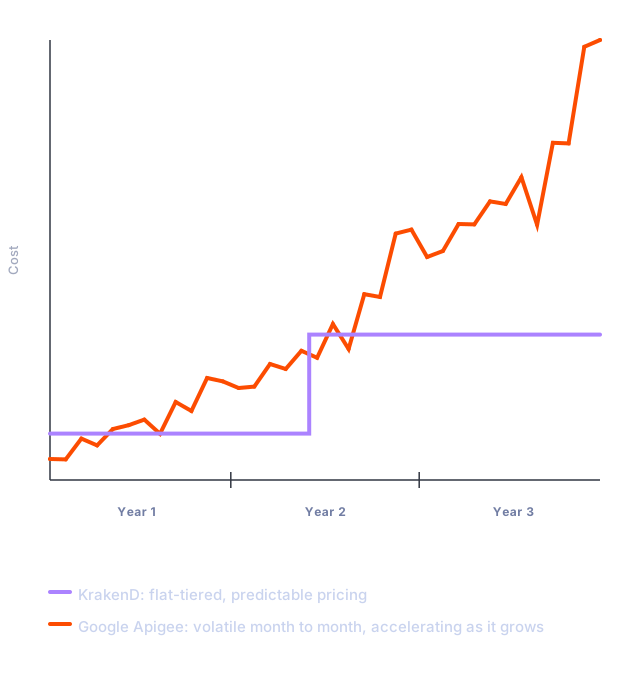
Google Apigee's per-call pricing has a structural trap: the tiers are not linear. Cross a volume threshold and the overage rate kicks in, often higher than your committed rate. The total bill does not scale smoothly. It jumps. A holiday campaign, a viral moment, a partner integration going live: each one is a cost event you did not budget for. You find out at end of month, after the traffic has already happened.

KrakenD is priced by flat-tiered plans. A traffic spike that doubles your call volume does not change your invoice. A record-breaking sales day costs the same as a quiet Tuesday. Your gateway cost is a line in the annual budget, not a variable you track weekly. Scale your traffic as fast as your business demands. The gateway bill stays the same.

Chart: KrakenD's flat-tiered cost versus Google Apigee's volatile, ever-rising per-call cost over three years
KrakenD: One gateway for APIs & AI Workloads
image G2 High Performer, Fall 2026
image G2 Momentum Leader, Fall 2026
image G2 Easiest Admin, Mid-Market, Fall 2026
image G2 Fastest Implementation, Small-Business, Fall 2026
image G2 Users Love Us, Fall 2026

Independent Data: G2 Fall 2026 API Management

Independent Data: G2 Fall 2026 API Management

Metric

KrakenD

Google Apigee

G2 quadrant

High PerformerContender

Meets Requirements

93%90%

Ease of Admin

93%90%

Ease of Setup

92%90%

ROI payback, Mid-Market

3 months11 months

Source: G2 Fall 2026 API Management reports. Data collected through July 28, 2026, published August 25, 2026. Third-party verified peer reviews, not vendor claims.

Real Teams. Real Migrations. Real Results.

With Kong and Apigee, you can't start small. The pricing doesn't allow it. As an R&D department, we were like: cool, these guys are open source. We can try it out and deploy it even before licenses are involved.

Nicolaas Taljaard Head of Technology Strategy and Partnership, Moniepoint

KrakenD played a vital role in our API transformation journey by protecting our business platforms boundary and exposing the business capabilities in a standard way to both internal and external audience.

Stefano Leopizzi Enterprise Architecture, lastminute.com
Read the Case Study »

What About AI?

Apigee's AI Capabilities Are Separate Policies. KrakenD's Are Native Config.

Google Apigee's AI capabilities, Model Armor, LLM Token Policies, Semantic Caching, exist as separate policies layered onto its control plane. Teams still configure, deploy, and manage each one as its own piece of the stack.

KrakenD's AI Gateway is native config: LLM routing, prompt guarding, semantic caching, token budgets, and an MCP server, all in the same binary you already run, no additional service to deploy. AI is not new infrastructure. It is a new pattern on the infrastructure you have.

See How KrakenD Governs LLM Traffic

KrakenD AI Gateway

Google Apigee Migration FAQ

Frequently Asked Questions

1. Is the migration a big-bang cutover or can we do it incrementally?

Incremental. Start with your highest-traffic, lowest-complexity routes. Run KrakenD alongside Google Apigee in parallel (dev and staging instances are unlimited across all plans, no licensing cost for the parallel period). Validate behavior route by route. No production traffic moves until your team is confident.

2. We use Google Apigee for identity management too. What happens to that?

This is the most common hidden complexity in a Google Apigee migration. KrakenD validates identity but does not manage it. Before migrating the gateway, your team will need identity management in a dedicated IdP: Keycloak, Auth0, Entra ID, Cognito, or equivalent. KrakenD then points at that IdP for JWT validation, OIDC, and OAuth2. The migration assessment call maps this dependency explicitly so it is in your plan from day one, not a surprise at week six.

3. We are on Google Cloud. Does KrakenD work there?

Yes. KrakenD runs as a standard Docker image on GKE or any Kubernetes cluster on GCP. It has no dependency on Google-specific services and no preference for any cloud provider. Teams that migrate from Google Apigee typically keep their GCP infrastructure and replace only the gateway layer.

4. Our Google Apigee policies are complex. How do they map to KrakenD?

Google Apigee policies including quota enforcement, JWT validation, CORS, transformation, and rate limiting have direct equivalents in KrakenD's declarative config. Custom logic beyond native policy support maps to Go plugins. The migration assessment call exists to go through your policy inventory and categorize each one before you commit.

5. How long does a migration take?

G2 Fall 2026 Mid-Market: KrakenD's average time to go-live is 2 months, with 100% of implementations done in-house. The actual timeline depends on the number of routes, the complexity of your Google Apigee policies, and whether identity management separation is in scope. A phased migration of a subset of routes can go live in days.

6. Google Apigee has a developer portal, analytics dashboards, and monetization features. Does KrakenD have equivalents?

No. KrakenD does not include a developer portal, API marketplace, monetization features, or built-in analytics dashboards. For observability, KrakenD emits data to your existing stack via native OpenTelemetry: Grafana, Datadog, New Relic, your SIEM. The data is yours, in the tools you already use, not locked inside a vendor dashboard. For developer portal and monetization, if those functions are in active use, they need a complementary tool as part of your migration plan. KrakenD's scope is the gateway layer: routing, auth, transformation, rate limiting, observability, and AI traffic governance. The migration assessment call will map which functions need a complementary tool and which are handled natively.

7. What about Google Apigee Hybrid, where the data plane is self-hosted?

Google Apigee Hybrid runs the data plane on your infrastructure but still requires Google's control plane for configuration management. KrakenD has no control plane. Configuration is a file in your Git repository. If the goal is full infrastructure independence from Google, Google Apigee Hybrid does not achieve it. KrakenD does.

Start the
Migration Conversation

Walk through your current Google Apigee setup, the policies involved, and what a phased, low-risk migration path looks like for your architecture.

Start the Migration Conversation    See the Full KrakenD vs Google Apigee Comparison

Stay up to date with KrakenD releases and important updates